
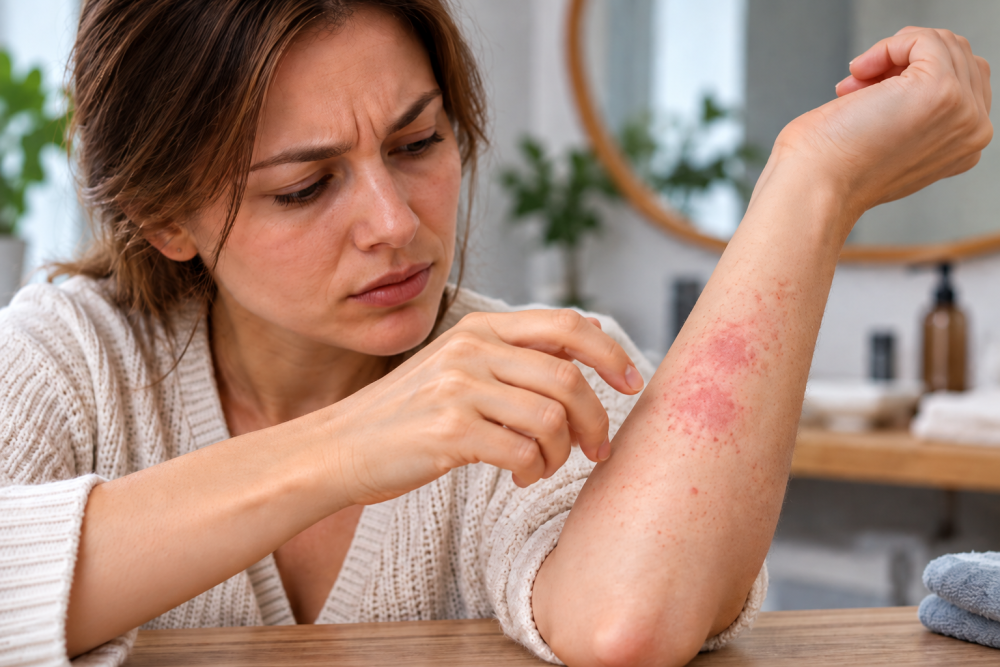
Red patches on the skin that don’t itch are most often caused by harmless or mild conditions such as rosacea, cherry angiomas, pityriasis rosea, guttate psoriasis, granuloma annulare, friction, heat or sun damage. Some non-itchy red patches, however, need prompt medical attention — spots that don’t fade when pressed (petechiae or purpura), the expanding “bull’s-eye” rash of Lyme disease, the butterfly rash of lupus, spreading warm redness of cellulitis and, rarely, early skin cancer. See a doctor if a patch spreads quickly, doesn’t blanch under a glass, lasts longer than 2–3 weeks, bleeds or doesn’t heal, or comes with fever, fatigue or joint pain.
Itching is the symptom most people expect from a rash, so a red patch that doesn’t itch can be confusing — and sometimes worrying. The good news: most causes are benign. Below, a doctor-style guide explains why some patches don’t itch, how to use the simple glass test at home, how to read the shape and location of a patch, which causes are harmless and which are red flags, and what a doctor will do to find the cause.
Why don’t some red patches itch?
Itching is mainly driven by histamine and other inflammatory messengers that stimulate itch nerve fibres — typical of eczema, allergic reactions, insect bites and hives. Many red patches involve a different process:
- Vascular changes — widened or extra blood vessels (rosacea, cherry angiomas, spider angiomas, birthmarks) make skin red without triggering itch nerves.
- Bleeding under the skin — petechiae and purpura are tiny bleeds from capillaries; they are usually flat and painless.
- Deeper or immune-driven inflammation — conditions such as granuloma annulare, lupus or some forms of psoriasis affect deeper layers or blood vessels and may cause little or no itch.
- Infection or tissue damage — cellulitis or sunburn usually hurt rather than itch.
Quick self-check: the glass test
Press the side of a clear drinking glass firmly against the patch. If the redness fades (blanches), it’s usually caused by dilated blood vessels or inflammation. If the spots stay clearly visible through the glass, blood has leaked under the skin — this always needs a medical check, and if you also have a fever or feel unwell, seek emergency care. On darker skin the test is easier to judge on paler areas such as the palms, soles or inside the eyelids.
Common causes of red patches that don’t itch
| Condition | What it looks like | Where it appears | Other clues | How urgent |
|---|---|---|---|---|
| Rosacea | Persistent flushing, visible vessels, sometimes bumps | Cheeks, nose, chin, forehead | Triggered by heat, alcohol, spicy food, sun | Routine appointment |
| Cherry angiomas | Bright red, smooth dots 1–5 mm | Trunk, arms | Increase with age, harmless | Not urgent |
| Pityriasis rosea | One larger “herald patch”, then oval pink patches | Chest, back — “Christmas tree” pattern | Often after a cold; clears in 6–10 weeks | Routine appointment |
| Guttate psoriasis | Small teardrop-shaped, slightly scaly spots | Trunk, arms, legs | Often 1–3 weeks after strep throat | Routine appointment |
| Granuloma annulare | Smooth ring of skin-coloured or red bumps | Backs of hands, feet, elbows | Usually painless and non-itchy | Routine appointment |
| Pityriasis versicolor | Pink, red-brown or pale patches, fine scale | Chest, back, shoulders | Worse in heat and humidity | Routine appointment |
| Friction, pressure, heat | Redness matching the shape of clothing or contact | Waist, thighs, straps | Fades within hours to days | Not urgent |
| Sunburn or photosensitivity | Red, warm, sometimes tender skin | Sun-exposed areas only | Some medications increase sensitivity | Not urgent unless blistering widely |
| Petechiae / purpura | Flat red-purple dots or patches that don’t blanch | Legs, anywhere | Bruising, bleeding gums, fever | Prompt — urgent with fever |
| Erythema migrans (Lyme disease) | Expanding red patch, often with clearer centre, 5 cm or more | Near a tick bite | Appears 3–30 days after the bite; flu-like symptoms | See a doctor within days |
| Lupus (malar rash) | Red “butterfly” across cheeks and nose, sparing the folds beside the nose | Face, sun-exposed skin | Joint pain, fatigue, mouth ulcers | Book a doctor |
| Cellulitis | Warm, swollen, painful redness that spreads | Often lower legs | Fever, chills, a break in the skin | Same-day care |
| Fixed drug eruption | Round dusky red or violet patch that returns in the same place | Lips, hands, genitals, anywhere | Recurs each time a specific medicine is taken | Book a doctor |
| Bowen’s disease, superficial BCC | Slowly growing, pink-red scaly patch that doesn’t heal | Sun-exposed skin, legs | Older adults, sun damage | Book a skin check |
| Secondary syphilis | Non-itchy red-brown spots, including palms and soles | Trunk, palms, soles | Weeks after a painless genital or mouth sore | Book a doctor promptly |
Harmless and mild causes
Rosacea
Rosacea causes persistent redness of the central face with visible small blood vessels, flushing and sometimes acne-like bumps. It usually stings or burns rather than itches. Common triggers include heat, hot drinks, alcohol, spicy food, sun and stress. It can’t be cured, but gentle skin care, daily sunscreen and prescription creams or laser treatment control it well.
Cherry angiomas
These bright red, smooth, dome-shaped dots are small clusters of blood vessels. They become more common after 30 and are completely benign. They don’t need treatment, but a dermatologist can remove them for cosmetic reasons — and should check any spot that bleeds repeatedly or looks different from the others.
Pityriasis rosea
This common rash, most often seen in teenagers and young adults, starts with a single larger oval “herald patch”. A week or two later, smaller pink oval patches appear on the chest and back, often lining up along skin creases. Itching is mild or absent. It is thought to be linked to a viral trigger and usually clears on its own within 6 to 10 weeks. Pregnant women with this rash should tell their doctor.
Guttate psoriasis
Guttate psoriasis appears as many small, drop-shaped, slightly scaly red spots, often a few weeks after a streptococcal throat infection. Unlike classic plaque psoriasis, it may itch very little. It can clear completely or, in some people, develop into long-term psoriasis — so a dermatologist review is worthwhile.
Granuloma annulare
Granuloma annulare forms smooth rings of small skin-coloured, pink or red bumps, typically on the backs of the hands, fingers, feet or elbows. It is usually painless and non-itchy, isn’t contagious and often fades on its own within months to a couple of years. It is often mistaken for ringworm — but antifungal creams won’t help.
Pityriasis versicolor
This harmless overgrowth of a yeast that normally lives on skin causes pink, red-brown or pale patches with fine scale on the chest, back and shoulders. It is more common in hot, humid weather and may itch mildly or not at all. Antifungal washes and creams treat it, though colour changes can take weeks to even out.
Friction, pressure, heat and sun
Tight waistbands, bra straps, backpacks, long sitting and hot baths can all leave temporary red marks. Sunburn causes red, warm, tender skin limited to exposed areas, and some medications — including certain antibiotics, diuretics and anti-inflammatory drugs — make skin burn more easily. These patches fade within hours to days once the trigger is removed.
Birthmarks and spider angiomas
Port-wine stains and “salmon patches” are flat vascular birthmarks present from birth. Spider angiomas — a central red dot with fine radiating vessels — are common in children and during pregnancy, but many new spider angiomas in an adult can be a sign of liver disease and are worth mentioning to a doctor.
Causes that need a doctor
Petechiae and purpura
Petechiae are pinpoint flat red or purple dots; purpura are larger patches. Both are bleeding under the skin and don’t fade under a glass. They can appear on the face after heavy vomiting or coughing, but they can also signal low platelets, clotting problems, blood-thinning medication effects, vasculitis, leukaemia or serious infection. Non-blanching spots with fever are a medical emergency because they can be a sign of meningococcal infection.
Lyme disease rash (erythema migrans)
After a bite from an infected tick, an expanding red patch — often 5 cm or more, sometimes with a clearer centre that gives a “bull’s-eye” look — can appear, usually within 3 to 30 days. It is typically not itchy or painful. Early antibiotic treatment is effective, so see a doctor even if you don’t remember the tick bite but have been in grassy or wooded areas.
Lupus
Cutaneous and systemic lupus can cause a red “butterfly” rash across the cheeks and bridge of the nose that spares the folds beside the nose, or red, scaly patches on sun-exposed skin that worsen after sunlight. Joint pain, fatigue, mouth ulcers, hair loss or unexplained fevers alongside the rash are reasons to ask your doctor about blood tests.
Cellulitis
Cellulitis is a bacterial infection of the deeper skin. The area becomes red, warm, swollen and painful, and the redness spreads — often on the lower leg. Fever and chills may follow. It needs antibiotics the same day; marking the edge of the redness with a pen helps doctors see whether it is spreading.
Medication reactions
Many drug rashes itch, but not all. A fixed drug eruption causes a round, dusky red or violet patch that reappears in exactly the same place each time the medicine is taken — common culprits include some pain relievers and antibiotics. Any rash with blistering, peeling, mouth sores or fever after starting a new medicine needs urgent care.
Skin cancer and precancerous changes
Superficial basal cell carcinoma and Bowen’s disease (squamous cell carcinoma in situ) often look like a flat, pink-red, slightly scaly patch that doesn’t itch or hurt and slowly grows. Actinic keratoses feel rough, like sandpaper, on sun-damaged skin. Rarely, persistent red patches that don’t respond to usual creams can be an early form of skin lymphoma. Any patch that lasts more than a few weeks, grows, crusts, bleeds or doesn’t heal deserves a skin check.
Secondary syphilis
A few weeks after a painless sore, syphilis can cause a non-itchy rash of red-brown spots, classically including the palms and soles, sometimes with fever or swollen glands. It is easily treated with antibiotics, so testing is important if there is any risk of exposure.
What the shape and location can tell you
- Face: rosacea, lupus butterfly rash, seborrheic dermatitis, sunburn; in children — the “slapped cheek” rash of fifth disease.
- Legs: petechiae, vasculitis, cellulitis, stasis changes in people with poor circulation, Bowen’s disease.
- Chest, back and trunk: pityriasis rosea, pityriasis versicolor, guttate psoriasis, cherry angiomas.
- Hands and feet: granuloma annulare; red-brown spots on palms and soles can suggest secondary syphilis or certain viral infections.
- Near a tick bite or after time outdoors: erythema migrans.
- Areas of pressure or rubbing: friction and pressure marks.
When to worry: red flags
Call emergency services or go to urgent care immediately if non-fading spots appear with fever, headache, stiff neck or you feel very unwell; if redness spreads rapidly and is hot and painful; if the face, lips or tongue swell or breathing becomes difficult; or if there are widespread blisters, peeling skin or sores in the mouth and eyes.
How doctors find the cause
- History and examination — when the patch appeared, whether it changes, recent infections, new medicines, travel, tick bites and other symptoms.
- Blanching test and dermoscopy — a magnifying light shows blood-vessel patterns and scale.
- Skin scraping — checks for fungal infection before any steroid cream is used.
- Blood tests — blood count and platelets, inflammation markers, autoimmune tests such as ANA, Lyme or syphilis serology when relevant.
- Skin biopsy — a small sample under local anaesthetic confirms the diagnosis for persistent or unusual patches.
Treatment depends on the cause
| Cause | Typical treatment |
|---|---|
| Rosacea | Trigger avoidance, sunscreen, prescription creams, oral medication, laser |
| Cherry and spider angiomas | No treatment needed; laser or electrocautery for cosmetic removal |
| Pityriasis rosea | Usually resolves on its own; moisturisers, sometimes light therapy |
| Guttate psoriasis | Topical treatments, light therapy; treating a strep infection if present |
| Granuloma annulare | Often observation; steroid creams or injections for persistent patches |
| Pityriasis versicolor | Antifungal shampoos, creams or tablets |
| Lyme disease rash | Oral antibiotics |
| Cellulitis | Antibiotics, rest, elevating the limb |
| Lupus | Sun protection, topical or systemic medication under specialist care |
| Drug eruption | Stopping the responsible medicine under medical advice |
| Bowen’s disease, superficial BCC | Creams, freezing, photodynamic therapy or minor surgery |
What you can do at home while you wait
- Take clear photos every few days in the same light to track changes.
- Note possible triggers: new medicines, cosmetics, foods, illness, travel, tick bites.
- Avoid steroid creams before a diagnosis — they can hide a fungal infection and make diagnosis harder.
- Use a gentle, fragrance-free cleanser and moisturiser and avoid scrubbing.
- Protect the area from the sun with clothing and SPF 30+ sunscreen.
- Don’t pick, squeeze or try to burn off spots at home.
Red patches on darker skin
Most medical images show redness on light skin. On brown and black skin, the same conditions can look purple, dark brown, grey or simply darker than the surrounding skin, and redness may be subtle. Texture changes, warmth, swelling, scaling and non-healing areas are often more useful signs — and the same red flags apply.
Frequently asked questions
Why do I have red patches on my skin that don’t itch?
Red patches that don’t itch usually come from widened blood vessels, mild inflammation or tiny bleeds under the skin rather than an allergic reaction. Common causes include rosacea, cherry angiomas, pityriasis rosea, guttate psoriasis, granuloma annulare, friction and sun damage. Less often they signal infection, a medication reaction, an autoimmune condition such as lupus, or a blood problem.
Should I worry about red spots on my skin that are not itchy?
Most non-itchy red spots are harmless, but see a doctor if they don’t fade when you press a glass on them, appear suddenly and spread, last more than two to three weeks, bleed or don’t heal, or come with fever, fatigue, joint pain or bruising. Non-fading spots with fever need emergency care.
What does it mean if red spots don’t fade when pressed?
Spots that stay red or purple under pressure (non-blanching) are usually petechiae or purpura — small bleeds under the skin. They can follow straining, coughing or minor trauma, but can also point to low platelets, vasculitis, medication effects or serious infection, so they should always be checked by a doctor, urgently if you feel unwell or have a fever.
Can stress cause red patches on the skin that don’t itch?
Stress doesn’t directly create most red patches, but it can trigger or worsen rosacea flare-ups, flushing, hives and psoriasis. If patches appear during stressful periods and fade afterwards, stress may be a trigger — but persistent patches still deserve a medical check.
Are non-itchy red patches a sign of skin cancer?
Rarely, but it’s possible. Superficial basal cell carcinoma and Bowen’s disease (early squamous cell carcinoma) often look like a pink or red, slightly scaly patch that doesn’t itch or hurt. Have a patch checked if it persists for more than a few weeks, slowly grows, bleeds, crusts or doesn’t heal — especially on sun-exposed skin.
What does a non-itchy red patch look like on dark skin?
On brown and black skin, inflammation often looks purple, dark brown, grey or simply darker than the surrounding skin rather than bright red. The same warning signs apply: changes in size, texture, bleeding, non-healing areas, or spots that don’t fade under pressure.
Sources
- American Academy of Dermatology. Patient information on rosacea, psoriasis, pityriasis rosea, granuloma annulare and skin cancer.
- Cleveland Clinic. Clinical overviews of petechiae, purpura, cherry angiomas and other causes of red skin spots.
- NHS. Guidance on rashes, non-blanching spots and when to seek urgent care.
- Centers for Disease Control and Prevention (CDC). Signs and symptoms of Lyme disease, including erythema migrans.
- Mayo Clinic. Information on lupus, cellulitis and drug reactions.
Medical disclaimer: This article is for informational purposes only and does not replace advice from a healthcare professional. Always consult a doctor or dermatologist about any new, changing or persistent skin patch.
[…] usually easy to tell apart from rashes; if you also notice unexplained skin changes, our guide to red patches on the skin explains when to […]