
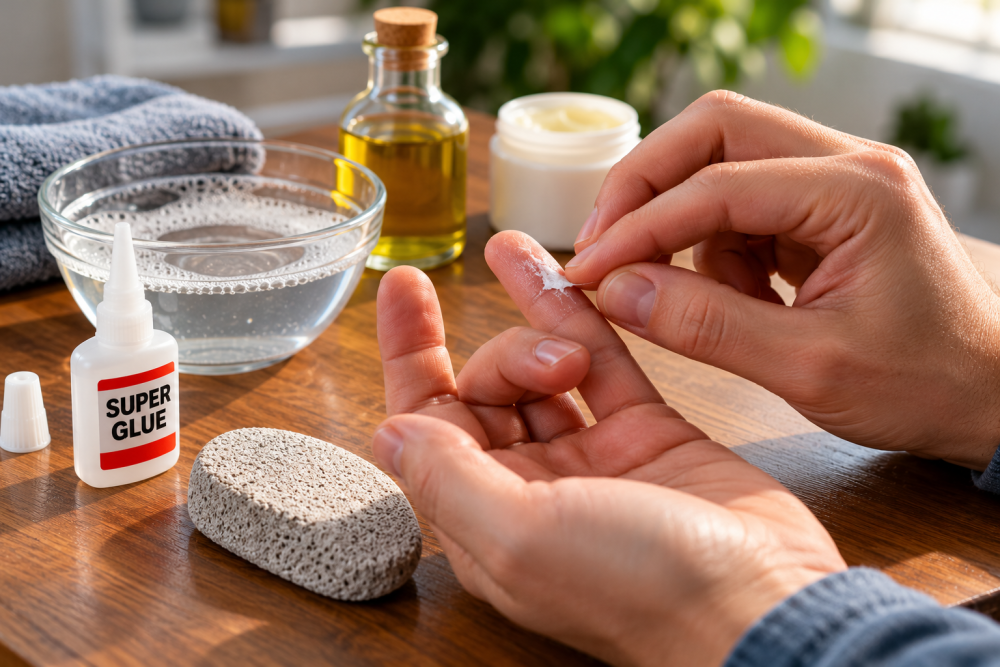
To remove super glue from skin, soak the area in warm, soapy water for 10–15 minutes and then gently peel or roll the softened glue away. If it’s still stuck, massage in a little oil, butter or petroleum jelly, rub lightly with a pumice stone, or dab a small amount of acetone-based nail polish remover on intact skin and wash it off afterwards. Never pull bonded skin apart, and don’t use acetone on cuts, the face or near the eyes. If glue is in or near the eyes, on the lips or in the mouth, covers a large area or has caused a burn, get medical help.
Super glue (cyanoacrylate) bonds to skin in seconds, but it sits only on the surface and isn’t usually harmful. The goal is to loosen it without damaging your skin. Here’s what works best, what to avoid, and when a small accident needs a doctor.
Why super glue sticks so fast
Super glue hardens when it reacts with moisture, and your skin is always slightly moist. That’s why it sets almost instantly on fingers. Because it only bonds to the outer layer of skin, it will loosen naturally within a few days as that layer sheds — removal just speeds this up.
Step-by-step: removing super glue from your hands and fingers
- Wash the area with warm water and mild soap.
- Soak it in warm, soapy water for 10–15 minutes to soften the glue.
- Gently peel or roll the edges of the glue away; use a fingernail or the edge of a spoon, not a blade.
- If it’s still stuck, massage in vegetable or olive oil, butter or petroleum jelly and wait a few minutes.
- Rub lightly with a pumice stone or a paste of salt and water, without scrubbing hard.
- For stubborn spots on intact skin, dab a small amount of acetone-based nail polish remover with a cotton pad, then wash well.
- Moisturize the skin afterwards — soaking and acetone can leave it dry.
Which method should you choose?
| Method | Best for | Watch out for |
|---|---|---|
| Warm soapy water | First step for any glue on skin | Takes patience; repeat if needed |
| Oil, butter or petroleum jelly | Sensitive skin, children, larger areas | Messy; wash off afterwards |
| Pumice or salt scrub | Thick, dried spots on hands | Don’t scrub hard or on broken skin |
| Acetone nail polish remover | Stubborn glue on small areas of intact skin | Dries skin; flammable; not near eyes, face or cuts |
| Waiting it out | Thin film that isn’t bothering you | Usually comes off in 1–4 days |
If your fingers are stuck together
Don’t pull them apart — the skin can tear. Soak your hand in warm, soapy water, then slowly peel or roll the fingers apart, easing them with the handle of a teaspoon. Add a little oil if needed and repeat the soak until they separate.
When to get medical help
- glue is in your eye or your eyelids are stuck together — don’t force them open;
- glue is on your lips or inside your mouth, or someone has swallowed glue;
- a large area of skin is covered, or the skin has burned or blistered;
- the skin is broken, bleeding or shows signs of infection afterwards;
- a young child has glue on their skin or in their mouth.
In the US, Poison Control is available at 1-800-222-1222 or online at poison.org. In an emergency, call your local emergency number.
What not to do
- don’t pull or cut bonded skin apart;
- don’t use sharp tools or blades to scrape glue away;
- don’t use acetone near the eyes, on the face, on cuts or on children;
- don’t use strong solvents such as paint thinner or gasoline;
- don’t scrub until the skin is red or raw.
If the skin around the glue spot turns red and irritated afterwards, it’s usually a mild reaction to scrubbing or acetone. For red marks that don’t settle, see our guide to red patches on the skin.
How to avoid getting super glue on your skin
- wear nitrile or vinyl gloves — not cotton, which can react with the glue and heat up;
- open tubes away from your face and point the nozzle down;
- keep a damp cloth and a bowl of soapy water nearby;
- store glue out of reach of children.
Common questions
How do I remove super glue from skin?
Soak the area in warm, soapy water for 10–15 minutes, then gently peel or roll the softened glue off. If that doesn’t work, massage in oil, butter or petroleum jelly, or dab a small amount of acetone-based nail polish remover on intact skin and wash it off afterwards. Never pull bonded skin apart.
Does super glue come off skin on its own?
Yes. Super glue doesn’t penetrate the skin, and as your skin naturally sheds and produces oils, the glue usually loosens and falls off within one to four days.
Is it safe to use acetone on skin?
Small amounts on intact skin are generally fine for a short time, but acetone dries and irritates the skin. Don’t use it on cuts, broken skin, the face, near the eyes or on young children, keep the room ventilated and away from flames, and wash it off and moisturize afterwards.
What should I do if my fingers are glued together?
Soak your hand in warm, soapy water, then slowly peel or roll the fingers apart, using the handle of a spoon to ease them gently. Don’t pull — bonded skin can tear. Repeat soaking if needed.
What if super glue gets in my eye or on my eyelids?
Don’t try to force the eyelid open. Rinse gently with warm water, cover the eye with a warm, damp cloth and get medical advice promptly. A healthcare professional can check for damage to the eye surface.
Can super glue burn the skin?
Yes, occasionally. Super glue releases heat as it sets, especially when large amounts touch cotton or wool fabric, which can cause a burn. Cool a burn under running water and see a doctor if it blisters or is large.
Sources
- Poison Control (National Capital Poison Center) — super glue exposures
- NHS — eye injuries and first aid
- Cleveland Clinic — skin care after chemical exposure
This article is for general information and isn’t a substitute for medical advice.