
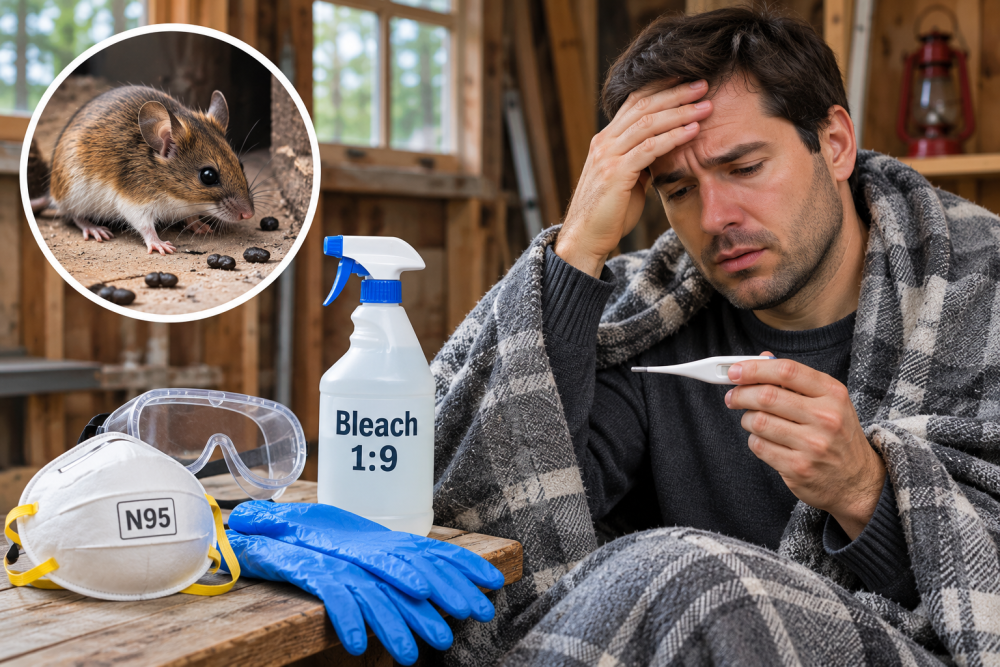
Hantavirus symptoms come in two stages: a flu-like early phase and a lung phase that can become life-threatening within 24–48 hours. If you develop a fever and muscle aches — especially in the thighs, hips or back — within 8 weeks of cleaning a cottage, shed, cabin or garage with mouse droppings, see a doctor the same day and say you were exposed to rodents; if you are short of breath, call 911. Acting during the early phase matters because there is no antiviral cure: survival depends on getting oxygen and intensive-care support before the lungs fill with fluid, and in North America about 1 in 3 people with hantavirus pulmonary syndrome die. The good news is that the illness is rare — Canada sees roughly 4 to 5 cases a year — and most fevers after a weekend at the cottage are ordinary flu or COVID-19, which usually come with a runny nose or sore throat that hantavirus rarely causes. One detail helps your doctor most: the date of the clean-up, since symptoms usually appear 2 to 3 weeks later and can take up to 8 weeks.
Early and late symptoms of hantavirus
In Canada, hantavirus causes hantavirus pulmonary syndrome (HPS), carried by the Sin Nombre virus in wild deer mice. The illness moves through clear phases, and what you should do changes with each one:
| Phase | When | Typical symptoms | What to do |
|---|---|---|---|
| Incubation | 1–8 weeks after exposure, most often 2–3 | none | note the date of any clean-up of mouse-infested space |
| Early (prodromal) | 3–6 days | fever, chills, fatigue, deep muscle aches in thighs, hips, back and shoulders; headache, dizziness; nausea, vomiting, diarrhea, belly pain | see a doctor the same day and mention rodent exposure |
| Lung (cardiopulmonary) | starts suddenly, can worsen within 24–48 hours | dry cough, shortness of breath, tight chest, fast heartbeat, low blood pressure | call 911 or go to the emergency department |
| Recovery | weeks to months for survivors | fatigue and reduced exercise tolerance | follow-up with your family doctor |
Hantavirus, flu or COVID-19: how to tell the difference
The early symptoms overlap, so no one can rule hantavirus in or out at home. These differences are what make doctors order a hantavirus blood test:
| Clue | Hantavirus (HPS) | Flu | COVID-19 |
|---|---|---|---|
| Recent exposure | closed cabin, shed or barn with mouse droppings 1–8 weeks ago | sick contacts, flu season | sick contacts |
| Runny nose, sore throat | rare | common | common |
| Muscle pain | severe, in large muscle groups — thighs, hips, back | common | common |
| Stomach symptoms | frequent: nausea, vomiting, belly pain | occasional, more in children | occasional |
| Breathing trouble | sudden, after 3–6 days of feeling unwell | uncommon in healthy adults | possible, usually gradual |
| Rapid test at home | none available | none for most people | yes |
How hantavirus spreads
- Breathing contaminated dust. When dried droppings, urine or nesting material from infected deer mice are disturbed, virus particles get into the air — the most common route by far.
- Touching, then your face. Handling droppings or dead mice and then touching your mouth or nose.
- Bites or broken skin — rare.
- Not from house mice, rats or pets. In Canada the virus has been found only in wild deer mice, and you cannot catch it from a cat or dog.
- Not from other people in North America. The South American Andes virus is the exception: in May 2026 the Public Health Agency of Canada confirmed an Andes hantavirus case in a British Columbia passenger of the MV Hondius cruise ship, isolated high-risk contacts and assessed the risk to the public as low.
Who is most at risk in Canada
Most cases occur in rural parts of Alberta, Saskatchewan, British Columbia and Manitoba, where deer mice are common. Alberta has recorded 81 cases and 15 deaths since 1989, including a death in 2026. Risk is highest when you enter a closed space where deer mice have been active: opening a cottage or trailer in spring, clearing a shed, barn or grain bin, working in crawl spaces, or doing construction, utility and pest-control work. Some patients never saw mice at all, so think about any closed, dusty building you entered in the past two months.
Diagnosis and treatment
Hantavirus is confirmed with blood tests for antibodies or viral genetic material; your doctor may also order a chest X-ray and blood counts, because a falling platelet count is an early warning sign. There is no specific antiviral or vaccine. Treatment is supportive and usually happens in intensive care: oxygen, a breathing tube if needed, careful fluid balance and medicines to support blood pressure, and in severe cases ECMO, a machine that takes over the work of the heart and lungs.
When to get help
- Call 911 if you have shortness of breath, chest tightness, a fast heartbeat or feel faint after recent rodent exposure.
- See a doctor the same day for fever with muscle aches within 8 weeks of cleaning or entering a mouse-infested space — and say so at triage.
- Call 811 (Health Link or your province’s health line) if you are unsure, or before cleaning a large infestation.
How to clean mouse droppings safely
- Open doors and windows and leave the space for at least 30 minutes.
- Put on rubber gloves, goggles and a respirator rated N95 or better — a dust mask is not enough.
- Gently pour (do not spray) a bleach solution of 1 part bleach to 9 parts water, or a household disinfectant, on droppings, nests and dead mice. Let it soak for 5–10 minutes.
- Wipe everything up with paper towels — never sweep or vacuum dry droppings.
- Double-bag the waste, seal it and put it in a garbage bin with a tight lid.
- Disinfect floors, counters and drawers; wash bedding and clothing in hot water.
- Wash gloves before taking them off, then wash your hands with soap and water.
To keep deer mice out, seal gaps in walls, doors and the roof, store food in rodent-proof containers and clear woodpiles and garbage away from the building.
Frequently asked questions
What are the first symptoms of hantavirus?
The first symptoms look like the flu: fever, chills, tiredness and muscle aches, especially in the thighs, hips, back and shoulders. Many people also have a headache, dizziness, nausea, vomiting, diarrhea or belly pain. They usually start 1 to 8 weeks after breathing in dust from deer mouse droppings, most often after 2 to 3 weeks.
How do you get hantavirus in Canada?
By breathing in tiny particles from the droppings, urine, saliva or nests of infected deer mice — usually while cleaning a closed cabin, cottage, shed, garage or crawl space. In Canada the virus has been found only in wild deer mice; house mice, rats and pets do not spread it.
Can hantavirus spread from person to person?
The strain found in Canada (Sin Nombre virus) does not spread between people. The Andes virus from South America is the exception and can spread through very close contact — that is why public health monitored contacts of the Canadian traveller who caught Andes virus on the MV Hondius cruise ship in 2026.
Is hantavirus curable?
There is no specific cure or vaccine. Patients are treated in hospital, usually in intensive care, with oxygen, careful fluid management and, in the most severe cases, a heart-lung machine (ECMO). Getting to hospital early, before breathing problems become severe, gives the best chance of survival.
How common is hantavirus in Canada?
It is rare: about 4 to 5 cases a year, mostly in rural areas of the western provinces. Alberta alone has recorded 81 cases and 15 deaths since 1989. But hantavirus pulmonary syndrome is serious — about 1 in 3 people who develop it in North America die.
How do I clean mouse droppings safely?
Air out the space for 30 minutes, put on rubber gloves and an N95 or better respirator, soak droppings and nests with a 1:9 bleach-to-water solution for 5–10 minutes, then wipe them up with paper towels and double-bag them. Never sweep or vacuum dry droppings, because that puts the virus into the air.
Sources: HealthLinkBC — Hantavirus pulmonary syndrome; Government of Alberta — Reducing the risk of hantavirus; Public Health Agency of Canada — Media update on Andes hantavirus, May 2026; CP24 — Hantavirus reminder as cottage season opens. This article is for general information and does not replace advice from a doctor.