
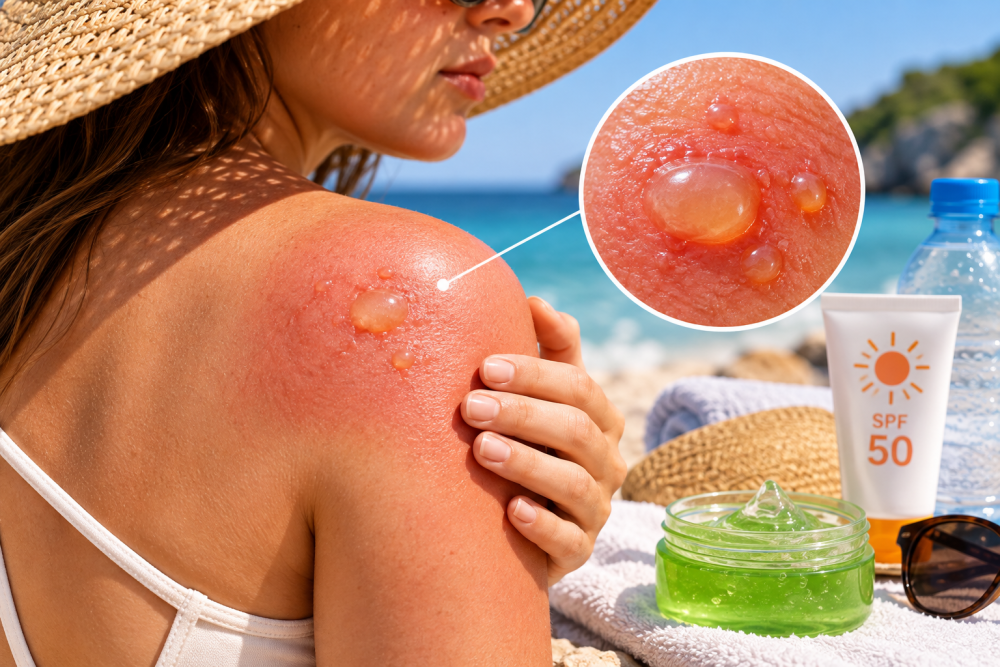
Sunburn skin blisters mean the burn has gone deeper than the top layer of skin — it is a second-degree sunburn. Don’t pop them: the blister roof protects the healing skin underneath. Cool the area with cool (not icy) water or damp compresses, use a fragrance-free moisturizer or aloe vera gel, drink extra fluids, and take ibuprofen or acetaminophen for pain if they’re safe for you. Most sunburn blisters heal in one to two weeks. See a doctor if blisters cover a large area, you have a fever, chills, confusion or signs of infection, or if a baby or young child is affected.
A red, sore sunburn is uncomfortable. A sunburn that bubbles up into fluid-filled blisters is a sign of more serious skin damage, and how you care for it in the first few days affects how quickly it heals and whether it gets infected. Here’s what blisters tell you, what to do and avoid, what to do if one breaks, and when to get medical help.
What sunburn blisters mean
Ultraviolet (UV) radiation damages skin cells. With a mild sunburn, only the outer layer is affected, and you get redness, warmth and tenderness. When the damage reaches the layer beneath, fluid collects between the layers and forms blisters. Doctors call this a superficial partial-thickness, or second-degree, burn.
Blisters usually appear several hours after sun exposure and can keep forming for up to a day or two. They often come with intense pain, swelling and sometimes symptoms that people call sun poisoning: fever, chills, headache, nausea or feeling generally unwell.
Do and don’t: caring for sunburn blisters
| Do | Don’t |
|---|---|
| Cool the skin with cool showers or damp compresses for 10–15 minutes several times a day | Put ice or ice packs directly on the skin |
| Leave blisters intact and let them drain on their own | Pop, squeeze or peel blisters |
| Apply aloe vera gel or a fragrance-free moisturizer around the blisters | Use butter, oils or petroleum jelly on unbroken, hot sunburned skin |
| Take ibuprofen or acetaminophen if they’re safe for you | Give aspirin to children or teenagers |
| Wear loose, soft clothing and stay out of the sun | Use numbing creams ending in “-caine”, which can irritate skin or cause allergic reactions |
| Drink extra water — burns draw fluid to the skin | Wear tight straps or rough fabrics over the blisters |
First 48 hours: step by step
- Get out of the sun and keep the burned area covered until it heals.
- Cool the skin with a cool shower or damp cloths; pat dry gently instead of rubbing.
- Apply a thin layer of aloe vera gel or fragrance-free moisturizer to the burned skin around the blisters.
- Protect blisters that rub against clothing with a loose, non-stick dressing.
- Take an over-the-counter pain reliever if it’s safe for you and follow the label directions.
- Drink more water than usual and watch for signs of dehydration: dark urine, dizziness, dry mouth.
- Check the blisters every day for signs of infection.
If a sunburn blister breaks
Blisters sometimes break on their own. When that happens:
- wash your hands, then rinse the area gently with clean water and mild soap;
- leave the loose flap of skin in place if you can — it acts as a natural dressing;
- apply a thin layer of petroleum jelly to keep the wound moist;
- cover it with a non-stick bandage and change it daily or when it gets wet or dirty;
- don’t pick at the edges or peel off dead skin.
How long sunburn blisters take to heal
| Time after sun exposure | What usually happens |
|---|---|
| Hours to day 2 | Redness, swelling and pain peak; blisters form |
| Days 2–5 | Blisters may drain and flatten; pain starts to ease |
| Days 5–10 | New skin forms underneath; peeling and itching begin |
| Up to 2 weeks | Most blistering sunburns have healed; skin can stay pink and sensitive for longer |
Healed skin is more sensitive to the sun for weeks, so keep it covered and protected.
When to see a doctor
- blisters cover a large area, such as most of your back, chest or legs;
- fever, chills, severe headache, confusion or fainting;
- nausea or vomiting, or you can’t keep fluids down;
- signs of infection: spreading redness, warmth, swelling, pus, red streaks or increasing pain;
- blisters on the face, eyelids or lips with swelling, or eye pain and vision changes;
- the person sunburned is a baby or young child, or is pregnant.
Seek emergency care for signs of heat stroke: very high body temperature, confusion, fainting or seizures.
Why some people blister more easily
- fair skin, red or blond hair and light eyes;
- time outdoors at midday, near water, snow or sand, or at high altitude;
- some medicines that make skin more sensitive to UV light, including certain antibiotics, diuretics, acne treatments and anti-inflammatory drugs;
- topical retinoids and some chemical peels;
- some skin conditions and recent cosmetic procedures.
If you develop blisters after only a little sun, ask your doctor or pharmacist whether a medicine could be making your skin more sensitive. Small itchy bumps after sun exposure can also be a sun allergy rather than a burn. For other skin changes that aren’t itchy, see our guide to red non-itchy patches on skin.
Blistering sunburns and skin cancer risk
Each blistering sunburn signals significant UV damage to skin cells, and repeated blistering sunburns — especially in childhood and the teenage years — are linked to a higher risk of melanoma and other skin cancers later in life. Keep an eye on moles and skin changes, and have a skin check if you’ve had many severe sunburns.
How to prevent sunburn blisters
- use a broad-spectrum sunscreen with SPF 30 or higher and reapply every two hours and after swimming or sweating;
- seek shade between roughly 10 a.m. and 4 p.m., when UV is strongest;
- wear a wide-brimmed hat, UV-blocking sunglasses and clothing that covers your skin;
- check the daily UV index;
- remember that clouds don’t block all UV, and water, sand and snow reflect it.
Common questions
Should I pop sunburn blisters?
No. The blister roof protects the raw skin underneath from infection and helps it heal. Leave blisters intact, protect them with loose clothing or a non-stick dressing, and let them drain and flatten on their own.
How long do sunburn blisters last?
Blisters usually appear within several hours to a day after sun exposure and settle over about one to two weeks. The skin may peel afterwards. Large, deep or infected blisters can take longer and should be checked by a doctor.
What should I do if a sunburn blister pops?
Wash the area gently with clean water and mild soap, leave the loose skin in place if you can, apply a thin layer of petroleum jelly and cover it with a non-stick bandage. Change the dressing daily and watch for signs of infection such as increasing redness, warmth, swelling, pus or fever.
Is a blistering sunburn a second-degree burn?
Yes. A sunburn that blisters has damaged deeper layers of the skin and is classed as a superficial partial-thickness, or second-degree, burn. It needs more careful care than a simple red sunburn.
When should I see a doctor for sunburn blisters?
Get medical advice if blisters cover a large area of your body, you have a fever or chills, feel dizzy, confused or very weak, can’t keep fluids down, see signs of infection, or if the person with blisters is a baby or young child. Seek urgent care for severe pain, fainting or signs of heat stroke.
Sources
- American Academy of Dermatology — How to treat sunburn
- NHS — Sunburn
- Skin Cancer Foundation — Sunburn and skin cancer risk
This article is for general information and isn’t a substitute for medical advice. If you’re worried about a sunburn, contact a healthcare professional.